
Carbon-Ceramic Rotor Reverse Engineering
We can develop a carbon-ceramic replacement for your original steel brake rotor, even when fitment data is unavailable. We use the original rotor’s dimensions to match its geometry.
There are three ways to get the dimensions we need:
- Measure your steel rotor using the guide below.
- Arrange a local 3D scan. Contact us first to agree on the file requirements.
- Ask us to buy a reference rotor. Its cost is included in your project quote.
We review the dimensions and confirm fitment before production.
What you need
- A precision caliper, preferably digital.
- A tape measure or long ruler for the rotor diameter.
- A rigid, straight bar long enough to bridge the rotor without bending.
- A phone or camera. A helper makes recording easier.
Record each measurement on video, or take a clear photo. Show the tool’s contact points and its reading so our engineers can check your measurements.
Measure your rotor
Use millimetres. Record front and rear rotors separately. The numbers in the photos are examples, not dimensions for your vehicle.
Click a photo to see it full size.
1. Overall diameter
From the back of the rotor, measure from one outer edge to the other through the centre.

Another view

2. Rotor thickness
Measure between the two braking faces with the caliper. Show where the jaws touch and any raised wear lip.

Another view

3. Friction ring width
From the back, measure the width of the braking surface from its inner edge to its outer edge.

4. Center bore diameter
Use the inside jaws of the caliper to measure the central opening in the rotor hat.

5. Mounting hole diameter
From the front, measure the inside diameter of a mounting hole in the rotor hat. Also record the number of mounting holes.

6. Bolt pattern and spacing
Record the bolt pattern if known. Measure the mounting-hole spacing as shown, with the holes and contact points visible in your photo. Our engineers use this to check the pitch circle diameter (PCD).
Hole-to-hole spacing is not the PCD itself. The guide’s 5 × 108 mm pattern is an example only.

7. Inner height
Work from the back of the rotor. Use the straight bar as a reference, then subtract its thickness from the height reading.
- Place the bar across the back of the rotor as shown below.
- Measure the bar thickness. Record this as A.
- Measure from the inner rotor face to the top of the bar. Record this as B.
- Calculate the inner height: B − A.
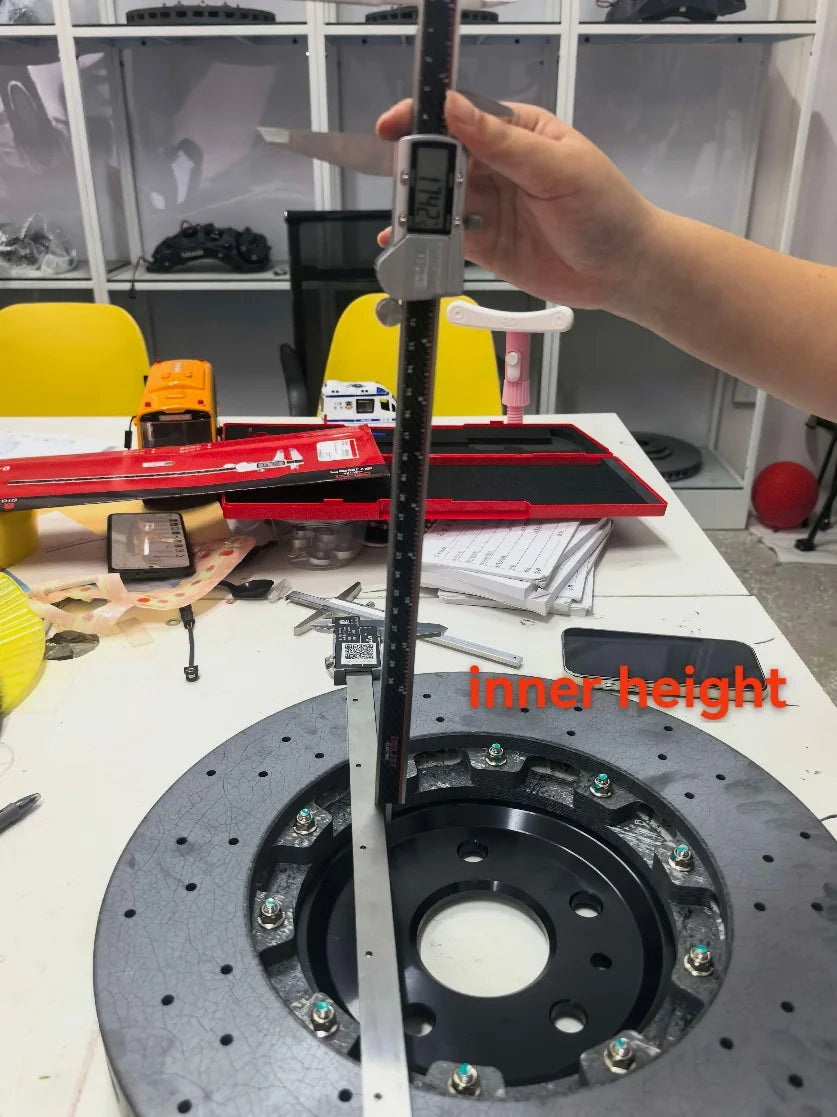
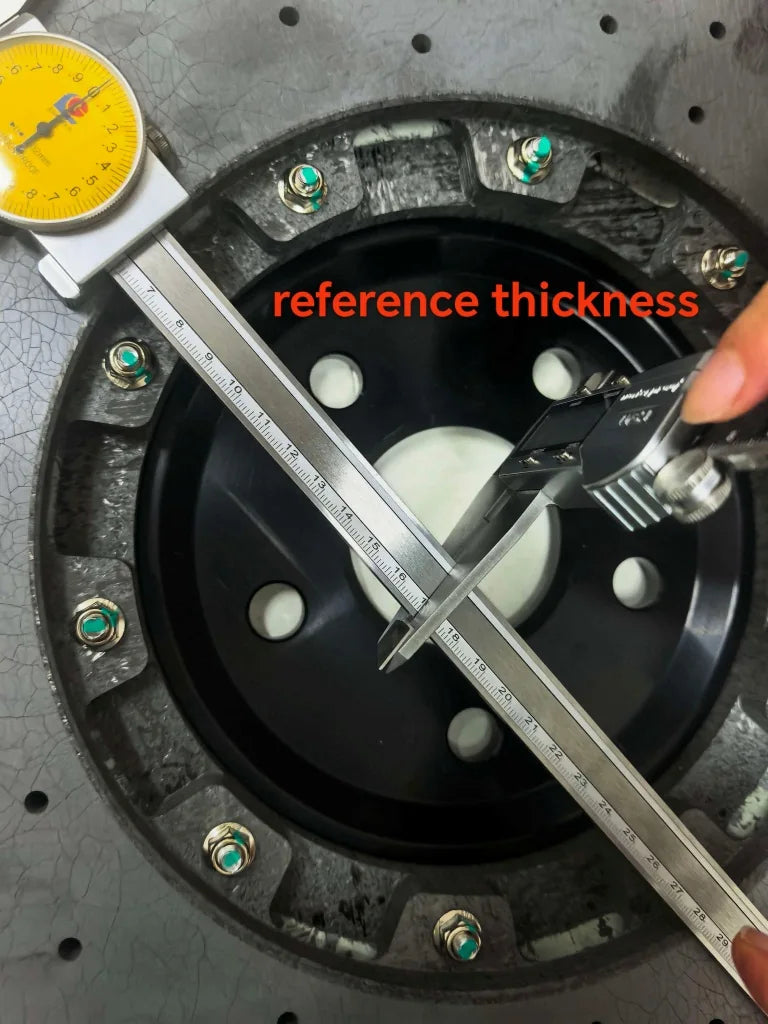
Example: A = 0.88 mm, B = 36.31 mm.
Inner height = 36.31 − 0.88 = 35.43 mm.
See photos of readings A and B
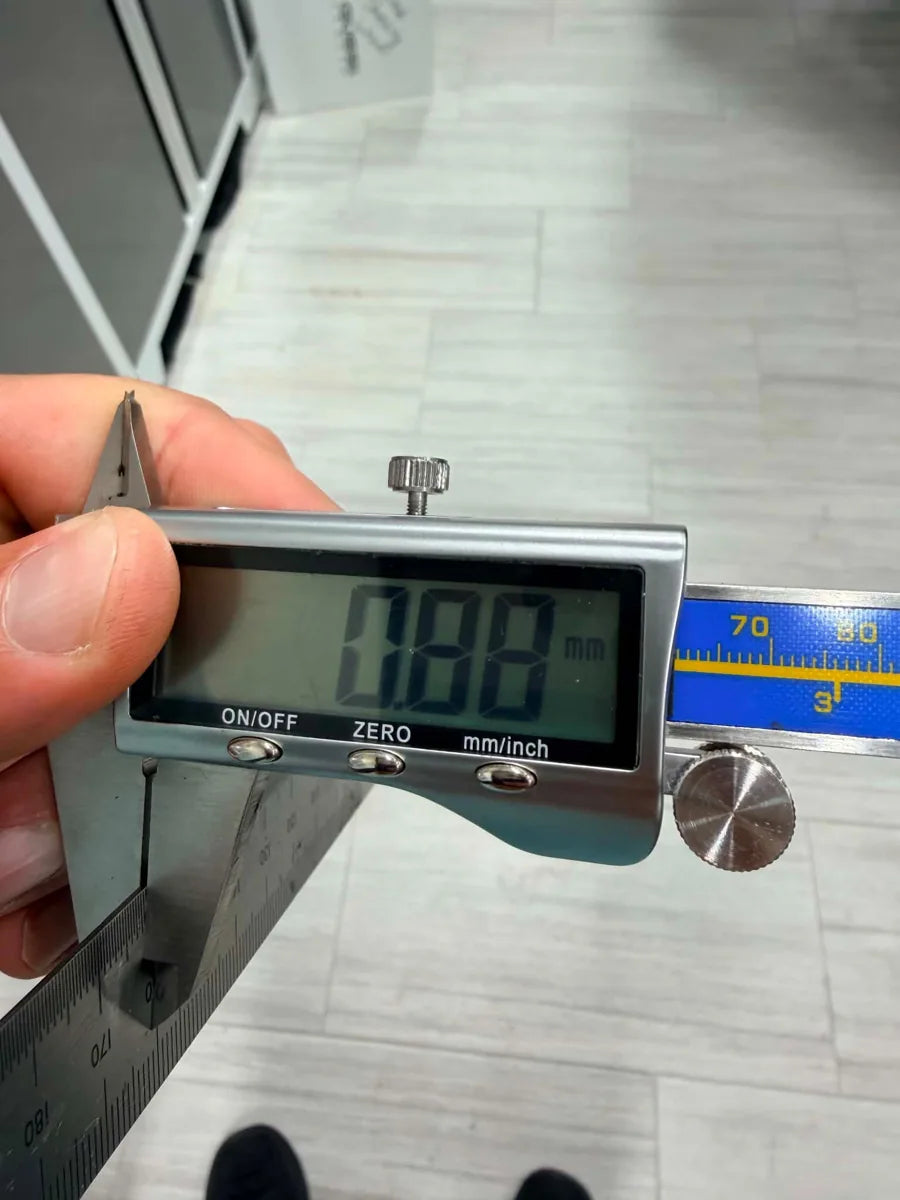
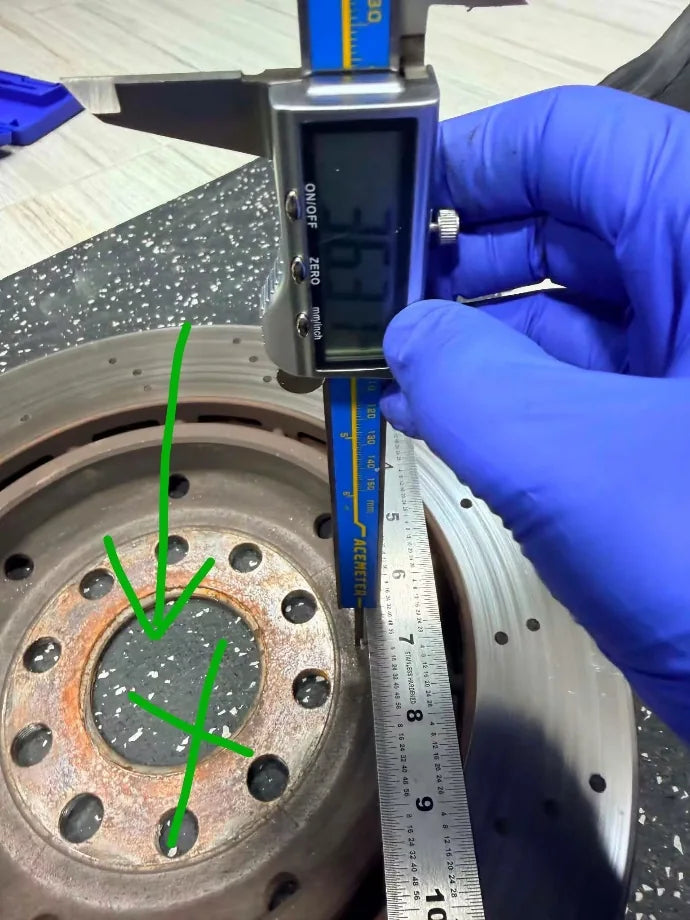
Send your own A and B readings, along with photos of the setup.
Example project: Audi A3 with TT RS brakes
A customer asked us for a carbon-ceramic conversion for his 2015 Audi A3. He had already retrofitted the brakes from a 2012 TT RS — stock TT RS calipers, steel rotors and pads.

That retrofit needs a caliper bracket to mount the larger caliper to the factory A3 steering knuckle, so the rotor can end up sitting differently than it would on a TT RS.
Our factory could have manufactured the brackets for him, but that route carries a risk of dimensional error. We advised him instead to measure the inner height of his own steel rotor — the method least prone to mistakes, because it describes the rotor exactly where it sits on his car. He sent us the video below.
The customer’s own measurement video.
What we produced
Using that inner height, we made a pair of front carbon-ceramic rotors, 370 × 32 mm, as a direct replacement for the TT RS steel rotors.

Final result
The customer fitted the rotors to the front axle himself. They mate to the TT RS caliper with correct pad alignment and clearance — fitment was confirmed on the car with no rework.


Your project follows the same route: send the measurements, we confirm the geometry, then we build the rotors to it.
Send your measurements
Include:
- Your vehicle’s make, model, year and brake option.
- Front or rear axle, and the original rotor part number if known.
- Your measurements and photos, video or a link to scan files.
Email forzaccb@forzaaa.com. We’ll review the information and confirm the next step.
No measurements yet? Send your vehicle details and ask us to source a steel reference rotor.